

In this collection · TMJ & Jaw Pain
TMJ & Jaw Pain
- TMJ Orthotics & Splints
- Laser & Photobiomodulation
- Joint Injections & PRF
- EMFACE for TMJ
- Cranial & Manual Therapy
TMJ Joint Injections & PRF
Targeted care, considered carefully.
PRF — platelet-rich fibrin — is prepared from a small sample of your own blood, concentrated to retain platelets and growth factors. For selected patients, a joint injection or PRF may be discussed after conservative care. It is not where treatment starts, and it is not a cure.
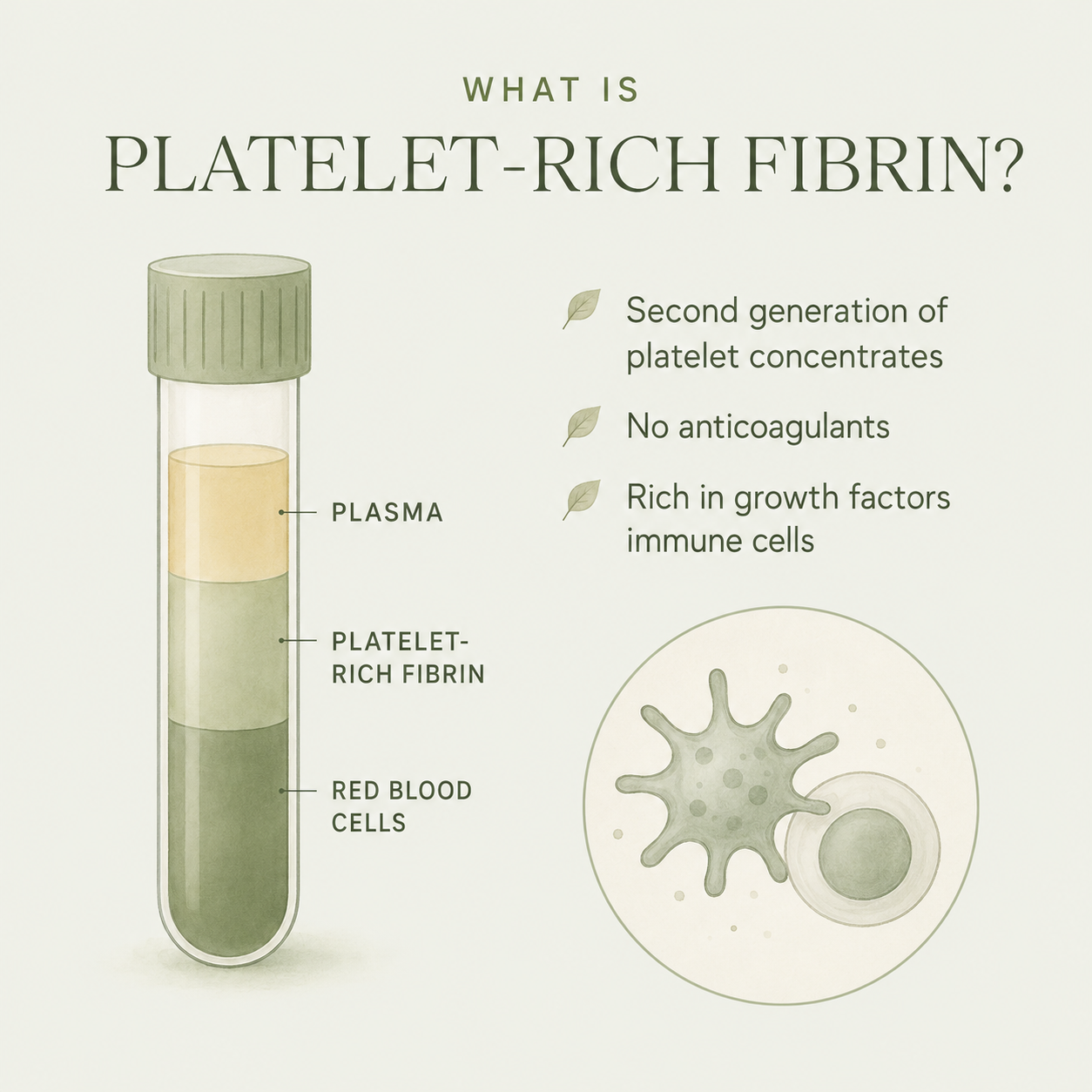
Using your body's own blood components
What is a PRF joint injection?
Platelet-rich fibrin (PRF) is prepared from a small sample of your own blood. The blood is processed in our office to concentrate platelets, fibrin and naturally occurring signaling proteins and growth factors. The resulting injectable PRF can then be placed into the temporomandibular joint when clinically appropriate.
In TMJ care, PRF may be considered for certain painful or inflammatory joint conditions as part of a larger conservative treatment plan. Research suggests platelet concentrates such as PRF and PRP may help reduce pain and improve jaw function in appropriately selected patients, although individual results vary and research continues to evolve.
PRF, plainly
Prepared from your own blood sample.
What PRF is
- A concentrate prepared from a small sample of your own blood
- Processed in our office and used the same visit
- Used with the goal of supporting the body’s own healing processes
- Discussed as one possible component of care for selected patients
- Explained fully before anything is agreed to
What PRF is not
- Not a way to regrow cartilage
- Not joint regeneration
- Not a stem cell treatment
- Not a cure for a TMJ disorder
- Not a guaranteed result — responses vary, and some patients notice little change
How PRF is prepared
A short, in-office process.
Nothing is brought in from outside your own body. Details specific to your care are discussed with you in person.
01
A small blood sample is drawn
02
It is processed in our office
03
A concentrate is prepared

Why we often prefer PRF
Several injection options. One individualized decision.
PRF
Prepared from the patient's own blood and contains platelets within a fibrin matrix along with naturally occurring signaling proteins. When appropriate, this is our preferred biologic joint-injection option.
Hyaluronic Acid
Hyaluronic acid may be used as an intra-articular option to support joint lubrication and movement in selected cases.
Corticosteroid
A corticosteroid injection may be considered when reducing joint inflammation is the primary short-term goal. It is not our default choice for every patient.
Lidocaine
Local anesthetic may be used in selected situations for anesthesia or short-term pain relief and may be incorporated into care depending on the procedure and clinical objective.
No single injection is right for every TMJ problem. The type of injection recommended depends on the diagnosis, symptoms, joint condition, medical history and goals of treatment.
Before your appointment
A little preparation can make the visit easier.
Hydrate well
PRF requires a blood draw, so arrive well hydrated. Drink plenty of water beginning the day before your appointment and continue drinking water the morning of your visit unless another healthcare provider has instructed you to restrict fluids.
Eat normally
Unless you have specifically been instructed otherwise, eat a normal meal before your appointment. PRF joint injections generally do not require fasting.
Tell us about medications and supplements
Make sure we have an accurate list of your medications, supplements, allergies and relevant medical conditions.
Plan for a lighter day
Most patients can return to normal daily activities, but the jaw or injection area may be temporarily sore. Avoid scheduling unusually strenuous activity immediately afterward when possible.

Do not independently stop prescribed medication
If you take blood thinners, aspirin, anti-inflammatory medication or other medications that may affect bleeding or platelet function, discuss them with our office and the prescribing healthcare provider. Do not stop a prescribed medication solely for this procedure unless specifically instructed by the appropriate clinician.
The appointment
From blood draw to joint injection.
01
Evaluation
We review your symptoms and joint findings and confirm that an injection is appropriate for your particular TMJ condition.
02
Blood draw
A small amount of blood is drawn from your arm, similar to a routine blood draw.
03
PRF preparation
Your blood is immediately processed in a centrifuge using our PRF protocol. This separates and concentrates the portion we want to use for treatment.
04
Joint injection
The treatment area is prepared and the PRF is carefully injected into the TMJ. Local anesthetic may be used when appropriate.
Treatment may involve one or both joints depending on your diagnosis and treatment plan.
After the injection
What should I expect afterward?
Temporary soreness, pressure, tenderness or a feeling of fullness around the treated joint can occur after an injection. Some patients may temporarily notice that the jaw feels different as the local anesthetic wears off or as the joint responds to the procedure.
Mild swelling or bruising can also occur around the injection or blood-draw site.
Improvement, when it occurs, is not necessarily immediate. PRF is not intended to function simply as a numbing injection, and response varies from patient to patient.
Post-treatment care
Give the joint a little room to recover.
Take it easy on the jaw
For the remainder of the day, avoid unnecessarily strenuous jaw activity. Choose foods that are comfortable to chew and avoid prolonged gum chewing, very chewy foods or intentionally testing how far you can open.
Gentle movement is okay
Normal comfortable jaw movement is generally appropriate unless the doctor gives you different instructions. Do not force stretching or aggressive jaw exercises immediately after treatment.
Stay hydrated
Continue drinking water normally after the procedure.
Follow your individualized medication instructions
Because PRF relies on the body's inflammatory and healing response, our office may provide specific recommendations regarding anti-inflammatory medications after treatment. Follow the instructions given specifically to you rather than starting or stopping medication on your own.
Continue your broader TMJ plan
A joint injection is often only one component of treatment. Continue your prescribed orthotic/splint use, exercises, physical or manual therapy, laser/PBM, or other recommended care unless instructed otherwise.

When should I call?
Please contact our office if you have concerns after treatment.
Seek prompt medical attention for symptoms such as:
- rapidly increasing or severe swelling
- significant or persistent bleeding
- fever or signs of infection
- difficulty breathing or swallowing
- a significant allergic-type reaction
- new or concerning neurologic symptoms
- severe or rapidly worsening pain
- any symptom that feels unusual or concerning
Expected mild soreness is different from severe or progressively worsening symptoms.
Treating the joint is not always the same as treating the whole problem.
TMJ symptoms can involve the joint itself, muscles, bite and jaw position, oral function, head and neck mechanics, habits, airway and sleep. A joint injection may help address an intra-articular component, but it does not automatically address every factor contributing to someone's symptoms.
At Alpine Airway Wellness, joint injections may be combined with other conservative treatments when appropriate, including:
- TMJ orthotics/splints
- photobiomodulation or laser therapy
- cranial/manual therapy
- exercises or functional therapy
- EMFACE for selected muscular concerns
Why it may be considered
When the joint is part of the picture.
- Persistent joint-area discomfort after conservative care
- Symptoms that have not responded to orthotic therapy alone
- Findings that point to the joint rather than muscle alone
- A preference for exploring options before considering surgical referral
- A situation where a trial of something targeted is clinically reasonable
Who it is not for
Where this is the wrong answer.
- Anyone who has not been properly evaluated
- Patients whose findings point primarily to muscle rather than joint
- Patients who have not yet tried appropriate conservative care
- Certain medical conditions or medications, assessed individually
- Anyone expecting regeneration, permanence or a guarantee
Combination care
One component, not the whole plan.
TMJ Orthotics & Splints
Where jaw position and load are part of the picture, orthotic care often continues alongside anything else.
Explore TMJ Orthotics & Splints →Laser & PBM Therapy
A low-level, non-cutting therapy considered for selected patients where comfort is the goal.
Explore Laser & PBM Therapy →Cranial & Manual Therapy
Gentle hands-on work for jaw, head and neck tension, considered for selected patients.
Explore Cranial & Manual Therapy →EMFACE for TMJ
Muscle conditioning discussed in a functional rather than aesthetic context.
Explore EMFACE for TMJ →Working with others
Referral to other specialists as needed
Oral and maxillofacial surgeons
Where findings suggest surgical evaluation, referral is the appropriate step rather than persistence.
Physicians
Pain, inflammatory and systemic conditions sometimes belong in a medical conversation.
Physical and manual therapists
Neck, posture and whole-body movement often influence how the jaw behaves.
The process
How care actually proceeds.
01
Evaluation
Joint, muscles, movement and history reviewed. Nothing is recommended before this.
02
A candid conversation
Whether an injection is reasonable for you, what it may and may not do, and what else is on the table.
03
Consent and planning
Details, considerations and any risks are discussed with the doctor before you decide anything.
04
Treatment
Performed in our Alpine office. Specifics of your care and aftercare are given to you directly.
05
Reassessment
An honest review of what changed. If it did not help, we say so and reconsider the plan.
A short note on sleep
Nighttime jaw activity has context.
For some patients, jaw load at night sits alongside sleep and breathing patterns. Where that seems relevant, it is worth understanding before assuming the joint alone explains everything. Adult sleep & airway care covers that side of the picture.
Questions
Questions about joint injections & PRF.
What is PRF?
Is an injection the first thing you would try?
How do I know if I am a candidate?
What exactly happens during the procedure?
What is recovery like?
How many treatments will I need?
How soon might I notice a difference?
Are there risks with a TMJ joint injection?
Do I keep using my orthotic?
Will insurance cover it?
What if it does not help?
How do I start?
Is PRF the same as PRP?
Why do I need to hydrate before PRF?
Do I need to fast?
Can I drive myself home?
Are there alternatives to PRF?
Clinically reviewed by Dr. Brittany Johansen. This page is general education, not a diagnosis or a treatment plan.
We see patients at our Alpine, Utah office, including families from Highland, Cedar Hills, American Fork, Lehi and across Utah County.
Start with an evaluation
A consultation in Alpine, Utah gives you a clear read on what is driving your jaw symptoms — and whether an injection belongs in your plan at all.