

In this collection · TMJ & Jaw Pain
TMJ & Jaw Pain
- TMJ Orthotics & Splints
- Laser & Photobiomodulation
- Joint Injections & PRF
- EMFACE for TMJ
- Cranial & Manual Therapy
TMJ Orthotics & Splints
Support the jaw. Don’t just protect the teeth.
A custom orthotic is designed around what your evaluation actually found — and adjusted as we learn how you respond.
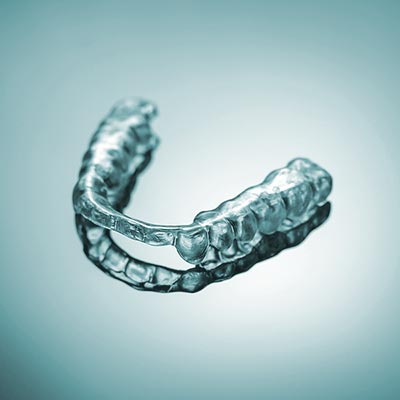
What an orthotic is for
Four things it may be asked to do.
Which of these applies depends entirely on the person wearing it.
01
Support jaw position
An orthotic may help support a jaw position that feels more comfortable for you, rather than assuming one position is universally correct.
02
Reduce strain
By changing how the jaw rests and loads, an orthotic may reduce muscle and joint strain for selected patients.
03
Protect teeth
Protection from clenching and grinding forces is part of what an orthotic does, but for TMJ care it is rarely the only goal.
04
Evaluate response
How symptoms respond to a supported position is diagnostic information in itself, and it informs what comes next.
A respectful comparison
Two different tools for two different jobs.
A simple nightguard
A sensible, common first step
- Primarily protects teeth from grinding forces
- Often a single, straightforward design
- Helpful for many people, and frequently enough
- Usually not adjusted over time
- Not designed around joint or muscle findings
A TMJ orthotic
Designed around your evaluation
- Designed from joint, muscle and function findings
- Aims to support jaw position, not only cover teeth
- Adjusted and reassessed as your response is observed
- Used as part of broader care, not on its own
- Individualized — there is no standard appliance

Who may be a candidate
Signs that an orthotic may be worth discussing.
None of these means an orthotic is required. They mean the conversation is reasonable.
- Jaw pain, clicking, or a sense of instability when opening
- Persistent symptoms despite wearing a nightguard
- Morning jaw soreness, headaches or facial muscle tension
- Clenching or grinding with joint symptoms alongside it
- Limited or uncomfortable opening
- Muscle tension that returns after it briefly settles
Evaluation first
Nothing is made before it is understood.
A proper evaluation looks at the joints and how they move, the muscles and where they hold tension, your bite, your history, and everything you have already tried.
Sometimes the answer is an orthotic. Sometimes it is something else entirely, or a combination. We would rather tell you that than hand you an appliance because it is the obvious product to sell.
Custom design
Individualized, and meant to evolve.
Made for your findings
The design follows what the evaluation showed — joint behaviour, muscle involvement, how your jaw moves and where symptoms sit.
Materials and coverage vary
Different designs suit different situations. What is appropriate for one patient may be entirely wrong for another.
Wear is individualized
When and how long an orthotic is worn is decided for you, in conversation, rather than from a standard schedule.
It is meant to change
Adjustment over time is part of the design, not a sign something went wrong. Response is observed and the appliance follows it.

The process
Five steps, paced to your response.
01
Evaluation
Joints, muscles, movement, bite and history — including whatever you have already tried.
02
Design
An orthotic designed around those findings, if an orthotic is the right tool for you at all.
03
Delivery
Fit, comfort and instructions, with a clear description of what we are watching for.
04
Adjustment
Refinement based on how you actually respond. Frequency depends on the person, not a calendar.
05
Reassessment
A candid review of what changed, what did not, and whether to continue, adjust or change direction.
Still having symptoms
“I’ve already tried a nightguard.”
That is a common and sensible starting point, and for many people it is enough. When symptoms persist despite one, it usually means the joints, muscles and jaw function deserve a closer look — not that the nightguard was the wrong idea, and not that nothing more can be done.
Explore TMJ & jaw pain care →Combination care
Rarely the only thing we do.
What is combined, and whether anything is combined at all, depends on your evaluation.
Laser & photobiomodulation
May be used alongside orthotic care for selected patients where muscle and joint comfort are part of the picture.
Explore Laser & PBM Therapy →Myofunctional therapy
Function and habit patterns can influence jaw load. Therapy is considered when the evaluation supports it.
Explore Myofunctional Therapy →Cranial & Manual Therapy
Gentle hands-on work for jaw, head and neck tension, considered for selected patients.
Explore Cranial & Manual Therapy →EMFACE for TMJ
Muscle conditioning discussed in a functional rather than aesthetic context for selected patients.
Explore EMFACE for TMJ →Sleep context
Jaw comfort and sleep can overlap.
For some patients, jaw symptoms and sleep-related breathing sit in the same picture. Where that is the case, an orthotic is considered alongside that context rather than in isolation.
A sleep-related appliance and a TMJ orthotic are not the same thing, and neither replaces medically directed care.
Questions
Questions about orthotics and splints.
What is a TMJ orthotic?
How is it different from a nightguard?
Are nightguards a bad idea?
I already wear a nightguard and still hurt. Why?
Will it fix my bite permanently?
How long will I wear it?
How often will it be adjusted?
Does it hurt?
Will it change my teeth?
Can it be combined with other treatment?
Does it relate to sleep or breathing?
How do I know if I’m a candidate?
Clinically reviewed by Dr. Brittany Johansen. This page is general education, not a diagnosis or a treatment plan.
We see patients at our Alpine, Utah office, including families from Highland, Cedar Hills, American Fork, Lehi and across Utah County.
Start with an evaluation, not an appliance.
A consultation in Alpine, Utah tells us whether an orthotic may help you, what it would be designed to do, and what a realistic plan looks like.