
Alpine Airway Wellness
In this collection

Children’s Mouth Breathing & Snoring

How a child breathes matters.

Mouth breathing and snoring are observations worth understanding — not conclusions. We evaluate the dental and craniofacial side of the picture, explain what we see, and coordinate with your child’s medical providers when that is the right next step.


Profile view of a young child outdoors in soft natural light
Young girl breathing calmly outdoors in golden morning light

Why It’s Worth Noticing

Breathing is part of how a child grows.

Childhood is a period of active facial and jaw development, and breathing happens every minute of it. That is why we treat habitual mouth breathing or regular snoring as something to understand rather than something to wait out.

Understanding is not the same as alarm. Many children we evaluate need monitoring, support for oral function, or a conversation with another provider — not treatment.

At Night

What parents notice after bedtime.

  • Snoring, on most nights or only sometimes
  • Sleeping with the mouth open
  • Restless sleep, frequent position changes or tossing
  • Noisy or effortful breathing
  • Night sweats or unusual sleeping positions
  • Frequent waking, or bedwetting beyond the expected age

During the Day

And what shows up in daylight.

  • Lips apart at rest
  • Dry lips or a dry mouth in the morning
  • Frequent congestion or a chronically stuffy nose
  • Fatigue, irritability or difficulty settling
  • Difficulty with focus or attention during the school day
  • Chewing, swallowing or picky-eating patterns

No item on either list is a diagnosis, and no single observation means something is wrong. Together, they are simply reasonable reasons to have your child evaluated.

Possible Contributing Factors

Usually more than one thing.

These are factors that may contribute in some children. Which ones apply to your child — if any — can only be determined through evaluation, and some of them sit with a medical provider rather than with us.
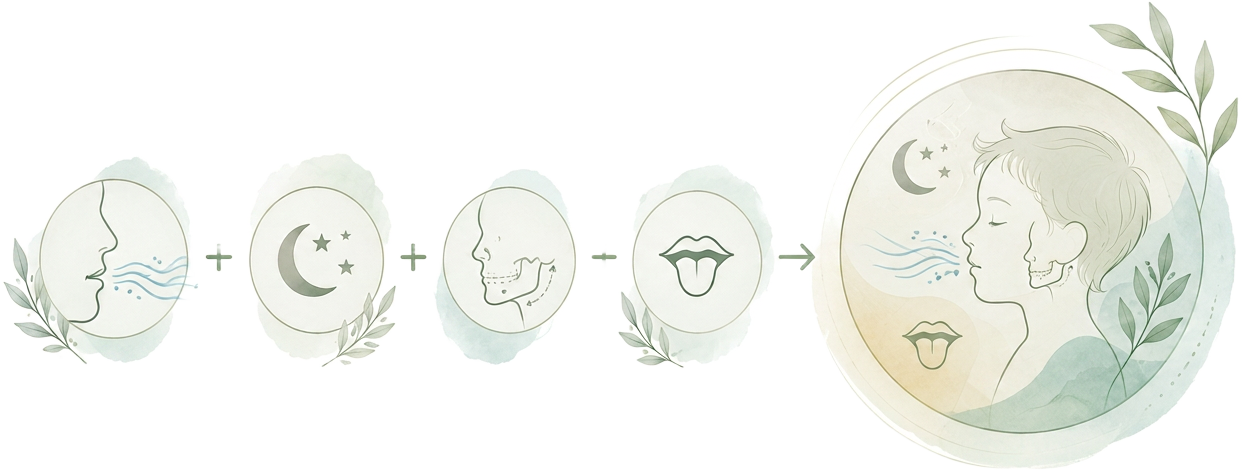
Illustration of contributing factors combining into a child's overall wellbeing: breathing, sleep, jaw development, and oral function.
Nasal airway
Congestion, allergies and nasal anatomy can make nasal breathing feel like more work than breathing through the mouth. These are medical questions we refer out.
Tonsils & adenoids
Enlarged tonsils or adenoids are a common consideration in children who snore. Evaluation and management belong with a physician or ENT.
Palate & arch width
A narrow or high upper arch may leave limited room for the tongue. This is part of what we can evaluate as dentists.
Oral function
Tongue posture, lip seal and swallowing patterns often travel together with habitual mouth breathing.
Restricted oral tissues
A tongue-tie or other restriction can limit where the tongue can rest and how it moves.
Growth & development
Facial and jaw development is ongoing in childhood, which is why patterns are worth understanding rather than assuming they will resolve on their own.

Scope of Care

What we evaluate — and what we don’t.

We are dentists. Our evaluation is dental and craniofacial. Sleep and airway conditions are medical diagnoses, made by physicians.

What we can evaluate

  • Palate width, arch shape and available tongue space
  • Bite relationships, crowding and how the teeth meet
  • Tongue posture, lip seal, swallowing and oral habits
  • Signs of clenching, grinding or jaw discomfort
  • Craniofacial growth and stage of development
  • What you have observed at home, at night and during the day

What belongs with a medical provider

  • Diagnosing sleep apnea or any sleep-disordered breathing condition
  • Interpreting or ordering sleep studies
  • Diagnosing or treating allergies, sinus disease or infections
  • Evaluating or managing tonsils and adenoids
  • Prescribing medical therapy for breathing or sleep

What to Expect

An unhurried, explanatory visit.

  1. Conversation

    We start with what you have noticed, at night and during the day.

  2. History

    We review your child's health history and any providers already involved.

  3. Clinical exam

    We evaluate palate, arch, bite, tongue posture, lip seal and oral function.

  4. Discussion

    We explain what we see, in plain language, and what it does and does not tell us.

  5. Next step

    That may be treatment, monitoring, a referral, or a combination.

Possible Next Steps

Care depends on the findings.

These are options that may be appropriate for some children. None of them is automatic.

Tongue-tie evaluation

Evaluating restricted oral tissues, and treating them when appropriate as part of a coordinated plan.

Learn About Tongue-Ties

Growth & Timing

Growing jaws give us a window.

Because the jaws and face are still developing, breathing patterns, tongue posture and arch development can be looked at together while growth is still underway.

Evaluating earlier does not mean treating earlier. It means having information at a moment when it is most useful.

Growth & Palatal Expansion →
Watercolor illustration of a child breathing deeply outdoors, with air lines, leaves, pine trees and distant hills
Side profile of a young person standing outdoors with relaxed, upright posture

We Look Beyond Teeth

Breathing is rarely a standalone finding.

Mouth breathing and snoring tend to sit alongside other observations — tongue posture, arch width, bite, sleep quality, clenching or grinding. Looking at them together is what makes the picture legible.

Children’s Airway & Growth →

Collaborative Care

We are one part of the team.

When breathing or sleep concerns may involve medical factors, we refer. When appropriate, we coordinate with your child’s pediatrician, ENT, sleep physician, dentist, orthodontist, myofunctional therapist and speech or feeding professionals so care stays connected.

Our Collaborative Approach →
PHYSICIANSENTSORTHODONTISTSMYOFUNCTIONAL THERAPISTSSPEECH & FEEDING PROFESSIONALSOTHER CARE PROVIDERSALPINEAIRWAYWELLNESS

Common Questions

Questions parents ask us.

Is snoring in children normal?
Occasional noisy breathing can happen, particularly during a cold. Snoring that a parent notices regularly is worth discussing with your child's healthcare providers rather than assuming it is nothing.
Does snoring mean my child has sleep apnea?
No. Snoring is an observation, not a diagnosis. Sleep apnea in children is a medical diagnosis made by a physician or sleep specialist. We can evaluate dental and craniofacial factors and refer when a medical evaluation is appropriate.
Why does my child breathe through their mouth?
There can be several contributing factors, including nasal congestion or allergies, tonsils and adenoids, arch width and tongue space, oral function and habit. Sorting out which factors apply requires an individual evaluation, and often more than one provider.
Will my child grow out of it?
Some patterns change as children grow, and some do not. Because facial and jaw growth is happening during childhood, we generally prefer to understand what is going on rather than wait and assume.
What can a dentist evaluate that a physician might not?
We focus on the dental and craniofacial side: palate width and shape, arch development, bite, tongue space and posture, lip seal, swallowing and oral habits. That is complementary to — not a substitute for — medical evaluation.
Do you order or interpret sleep studies?
No. Sleep studies are ordered and interpreted by physicians. If a medical evaluation appears appropriate, we will say so and coordinate with your child's pediatrician, ENT or sleep provider.
Does treatment always follow an evaluation?
No. Many children are evaluated and the recommendation is monitoring, a referral, or supporting oral function. We only recommend treatment when the findings support it.
Can you work with our pediatrician or ENT?
Yes. When appropriate we coordinate with your child's pediatrician, ENT, sleep physician, myofunctional therapist, speech or feeding therapist and other providers so everyone understands the goals of care.

Clinically reviewed by Dr. Brittany Johansen. This page is general education, not a diagnosis or a treatment plan.

We see patients at our Alpine, Utah office, including families from Highland, Cedar Hills, American Fork, Lehi and across Utah County.

Serving Alpine & Utah County

Start with a conversation.

If your child snores, breathes through their mouth, or sleeps restlessly, a consultation at our Alpine, Utah office can help you understand what you’re seeing and what kind of evaluation makes sense next.

Request an Appointment