
Alpine Airway Wellness

Myofunctional Therapy

The mouth is a muscle system. It can be retrained.

Myofunctional therapy works on how the tongue rests, how the lips seal, how you breathe and how you swallow. It supports airway, orthodontic, tongue-tie and TMJ care for both children and adults — and it is one part of a plan, never a promise on its own.

A parent and young child sharing a warm, playful moment outdoors in soft light

What We Look At

Four functions that happen thousands of times a day.

Breathing
Whether nasal breathing is comfortable and habitual, at rest and during sleep.
Tongue posture
Where the tongue rests when the mouth is closed and nothing else is happening.
Lip seal
Whether the lips come together easily and stay that way without effort.
Swallowing
How the tongue moves during a swallow, and what the surrounding muscles do.

Plain Language

What myofunctional therapy is — and isn’t.

What it is
A structured, exercise-based program that retrains the muscles and habits of the tongue, lips, face and airway function.
How it works
Short, repeated practice over time, guided by a trained provider, with progress reviewed as habits change.
What it supports
It is most often used alongside other care — orthodontic, airway, tongue-tie release or TMJ management — rather than on its own.
What it is not
It is not a cure, a guarantee, or a substitute for medical evaluation and treatment. Results vary, and effort matters.

Who It May Suit

Patterns that lead people here.

These are observations, not diagnoses. Whether therapy is appropriate is decided through evaluation.

In children

  • Lips apart at rest
  • Habitual mouth breathing
  • A tongue that rests low or forward
  • Chewing, swallowing or picky-eating patterns
  • Speech articulation concerns already being addressed elsewhere
  • Persistent thumb, finger or pacifier habits

In adults

  • Mouth breathing or a dry mouth on waking
  • Difficulty keeping the lips comfortably closed
  • Tongue posture that feels low or unsupported
  • Jaw or facial muscle tension
  • Clenching or grinding noted by a dentist
  • Ongoing airway, orthodontic or TMJ care where function is part of the picture

Where It Fits

Therapy rarely stands alone.

It usually accompanies other care. Here is how it connects across the practice.
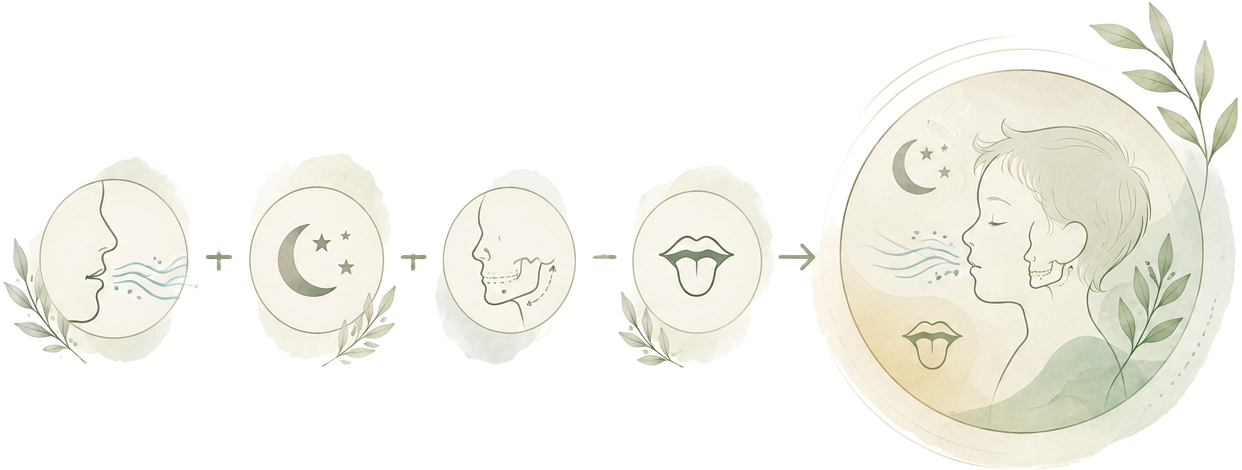
Watercolor illustration showing how breathing, sleep, jaw and tongue function combine into whole-person care

Children's airway & growth

When breathing habits, tongue posture and oral function are part of what we're evaluating during growth.

Children's Airway & Growth

Early & functional orthodontics

Function is often addressed alongside arch development and alignment. Therapy does not guarantee orthodontic stability.

Early & Functional Orthodontics

Palatal expansion

When arch width changes, tongue space changes too. Therapy can support how that space is used.

Palatal Expansion

Tongue-tie treatment

Therapy is frequently recommended before and after a release. Outcomes depend on the individual and are not guaranteed.

Tongue-Tie Treatment

Adult sleep & airway

Sleep apnea is a medical diagnosis, made and managed by physicians. Therapy is supportive care, never a replacement for it.

Adult Sleep & Airway

TMJ & jaw pain

Muscle habits, posture and clenching patterns can be part of a broader TMJ plan.

TMJ & Jaw Pain

How Care Unfolds

Evaluate, practice, review.

  1. Evaluation

    Function is assessed — breathing, tongue posture, lip seal, swallowing and related habits.

  2. Findings

    We explain what we see and whether therapy is likely to be useful for you.

  3. Program

    A tailored set of exercises, practiced regularly between visits.

  4. Review

    Progress is reviewed and the program adjusted as habits change.

  5. Coordination

    We stay in contact with the other providers involved in your care.

Scope & Boundaries

Where dental care ends and medical care begins.

  • Sleep apnea and sleep-disordered breathing are medical diagnoses, made by physicians.
  • Myofunctional therapy is not a treatment for sleep apnea and does not replace prescribed therapy such as CPAP or physician-directed care.
  • Nasal obstruction, allergies, tonsils and adenoids are evaluated and managed medically.
  • We do not claim therapy cures mouth breathing, resolves TMJ disorders, guarantees orthodontic stability, or determines tongue-tie outcomes.
  • Speech and feeding diagnoses belong with speech-language and feeding professionals.

Collaborative Care

Coordinated with everyone else involved.

Depending on the situation, that may include your dentist, orthodontist, pediatrician, ENT, sleep physician, speech or feeding professional, physical therapist, chiropractor or bodyworker.

Our Collaborative Approach →
PHYSICIANSENTSORTHODONTISTSMYOFUNCTIONAL THERAPISTSSPEECH & FEEDING PROFESSIONALSOTHER CARE PROVIDERSALPINEAIRWAYWELLNESS

Common Questions

Questions we’re asked most.

What is myofunctional therapy?
It is an exercise-based program that retrains the muscles and habits involved in tongue posture, lip seal, nasal breathing and swallowing. It is guided by a trained provider and practiced consistently at home.
Who is it for?
Children and adults whose evaluation shows oral-function patterns that may be contributing to a broader concern. It is not appropriate or necessary for everyone, and we will say so when it isn't indicated.
Does it treat sleep apnea?
No. Sleep apnea is a medical diagnosis, made and managed by physicians. Myofunctional therapy may be used as supportive care within a physician-directed plan, but it does not replace appropriate medical treatment and we do not present it as a cure.
Will it stop my child's mouth breathing?
We cannot promise that. Mouth breathing can have medical contributors — nasal obstruction, allergies, tonsils and adenoids — that therapy does not address. Therapy can support habit change once those factors have been evaluated.
How long does a program take?
It depends on findings, age and how consistently the exercises are practiced. We discuss expected scope at the start and review it as therapy progresses rather than quoting a standard length.
Is it needed before or after a tongue-tie release?
It is frequently recommended around a release so that new mobility is actually used, but the specifics are individual and outcomes vary. That decision is made case by case.
Will it keep my orthodontic result stable?
Function is one factor among several in stability, and therapy is not a guarantee against relapse. Retention plans are determined with your orthodontic provider.
Can it help with jaw pain or clenching?
For some people, muscle and posture habits are part of the picture, and therapy is used as one component of a broader plan. It is not a standalone TMJ treatment.
Do I need a referral?
No. You can schedule an evaluation directly, and we are also glad to coordinate with a dentist, orthodontist, physician or therapist who suggested it.
What if therapy isn't right for us?
Then we will tell you. Recommending it when the findings don't support it would not serve you.

Clinically reviewed by Dr. Brittany Johansen. This page is general education, not a diagnosis or a treatment plan.

We see patients at our Alpine, Utah office, including families from Highland, Cedar Hills, American Fork, Lehi and across Utah County.

Serving Alpine & Utah County

Find out whether therapy makes sense for you.

An evaluation at our Alpine, Utah office will tell you what your oral function looks like now, whether myofunctional therapy is indicated, and what else may belong in the plan.

Request an Appointment