

In this collection · Children's Airway & Growth
Children's Airway & Growth
- Mouth Breathing & Snoring in Children
- Palatal Expansion
- Early & Functional Orthodontics
- Tongue-Tie Evaluation & Treatment
- Myofunctional Therapy
Tongue-tie & oral function
A tongue-tie is about function—not just appearance.
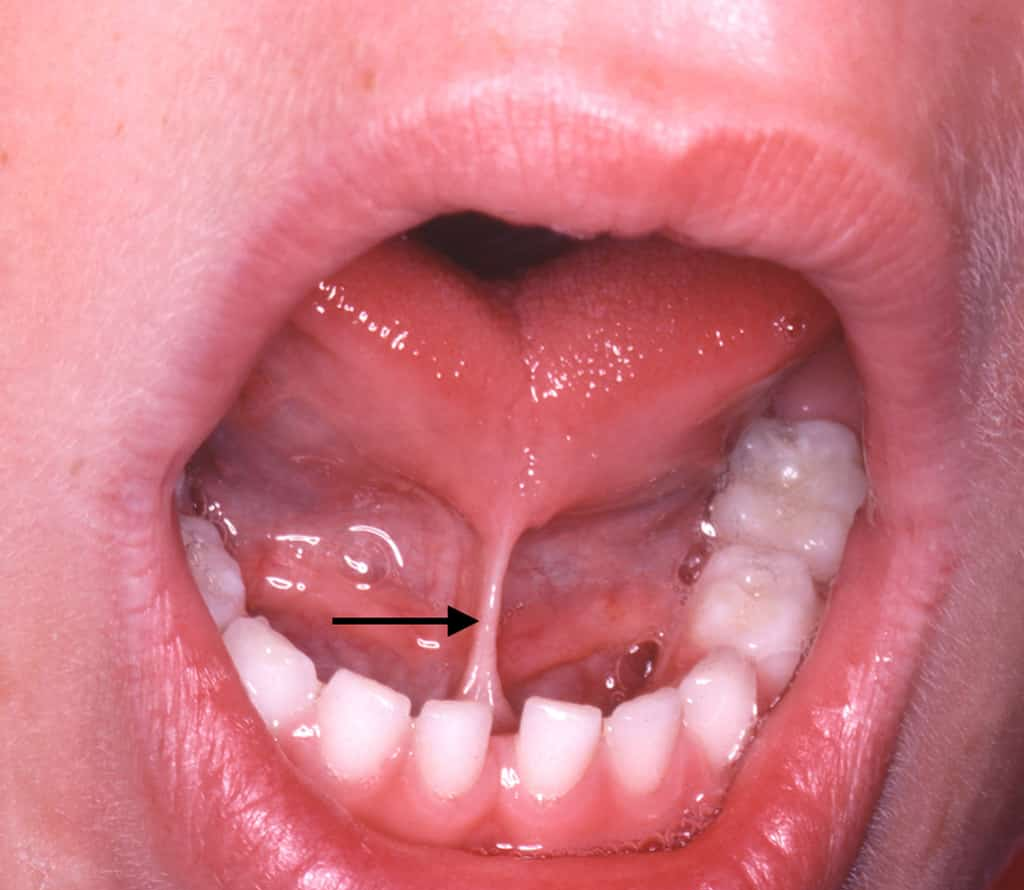
A tongue-tie occurs when the tissue beneath the tongue restricts its movement or function. What matters most is not simply how the tissue looks, but how the tongue moves and whether that restriction may be contributing to concerns with oral function, feeding, swallowing, speech, breathing or development.
At Alpine Airway Wellness, we evaluate the tongue as part of the larger oral and airway system before determining whether treatment may be helpful.

Looking at function
We don’t diagnose a tongue-tie by appearance alone.
A visible or prominent frenum does not automatically mean treatment is needed. Evaluation considers how the tongue actually functions within the mouth and how it interacts with breathing, swallowing, speech, feeding, jaw development and oral posture.
What we may evaluate
- Tongue mobility
- Ability to elevate the tongue
- Resting tongue posture
- Lip seal and nasal breathing
- Swallowing patterns
- Feeding concerns when relevant
- Speech concerns when relevant
- Palatal and jaw development
- Other oral restrictions
- Symptoms and functional limitations
Reasons families ask
Sometimes the clues show up somewhere else.
No individual symptom proves that a tongue-tie is present or that treatment is needed. Each of the concerns below may coexist with a restriction, and each can have several other explanations. They are simply reasons an evaluation may be worthwhile.
In children
- Difficulty with tongue movement
- Feeding or chewing concerns
- Difficulty maintaining comfortable lip closure
- Mouth breathing
- Low tongue resting posture
- Speech concerns
- Narrow or high palate
- Oral habits or dysfunctional swallowing patterns
A tongue restriction can be one contributing factor among several, and it may be considered during evaluation alongside nasal breathing, growth and habits.

When is a release appropriate?
Finding a restriction doesn’t automatically mean releasing it.
Treatment recommendations are based on function, symptoms, age, development and the overall clinical picture. For some patients, observation or functional therapy may be appropriate. For others, a tongue-tie release may be considered as part of a coordinated treatment plan.
The goal is improved function — not simply changing how the tissue looks.
Before & after
Releasing tissue is only part of the picture.
Alpine Airway Wellness generally recommends myofunctional therapy when appropriate before and after a tongue-tie release.
Learn About Myofunctional TherapyBefore
Therapy can help establish awareness, mobility and functional patterns, so that any decision about treatment is made with a clearer picture.
After
Therapy can help patients learn to use their new range of motion and support appropriate healing and function.
Our approach
Precise laser treatment with function in mind.
When treatment is indicated, Alpine Airway Wellness uses the Fotona laser to perform frenectomy and frenuloplasty procedures. The laser allows us to precisely release restricted tissue while controlling the treatment area.
Depending on the individual procedure and clinical needs, the site may be allowed to heal without sutures or may be stabilized with PeriAcryl or traditional sutures. Treatment recommendations and technique are individualized for each patient.

What to expect
Four steps, in order.
Timelines vary by patient and by procedure, so we describe the sequence rather than promising a specific recovery window.
- 01
Evaluation
We evaluate oral structure, tongue mobility, symptoms and function.
- 02
Preparation
When appropriate, myofunctional exercises or therapy may begin before the procedure.
- 03
Release
Restricted tissue is carefully released with the Fotona laser according to the individualized treatment plan.
- 04
Healing & Retraining
Follow-up care and functional exercises help support healing and use of the tongue's new range of motion.
Collaborative care
The tongue doesn’t work in isolation.
Tongue function can overlap with feeding, speech, breathing and growth. When it is helpful — and only when it is — we coordinate with the providers already involved in your child’s care. Most patients do not need all of them.
- Myofunctional therapists
- Speech-language pathologists
- Pediatricians
- ENTs
- Lactation professionals for younger children
- Orthodontic and dental providers
- Other members of the patient's healthcare team
Common questions
Questions parents ask first.
Does every tongue-tie need to be released?
How do you determine whether a tongue-tie is significant?
Do you use a laser for tongue-tie releases?
Will my child need stitches?
Why is myofunctional therapy recommended?
Can a tongue-tie cause mouth breathing or sleep problems?
What age can a child be evaluated?
Does a tongue-tie release replace speech or myofunctional therapy?
Clinically reviewed by Dr. Brittany Johansen. This page is general education, not a diagnosis or a treatment plan.
We see patients at our Alpine, Utah office, including families from Highland, Cedar Hills, American Fork, Lehi and across Utah County.
Related reading
Where this connects.
Myofunctional therapy
Exercise-based retraining of tongue posture, lip seal and swallowing, before and after a release when indicated.
Learn About Myofunctional TherapyMouth breathing & snoring in children
Why open-mouth breathing and noisy sleep are worth evaluating, and what else can contribute.
Read the ArticlePalatal expansion
How arch width relates to tongue space during growth — and what expansion does not do on its own.
Read the ArticleStart with an evaluation
Concerned about your child’s tongue function?
An evaluation can help determine whether a restriction is present, whether it is affecting function, and whether treatment — or simply monitoring — is appropriate.